




Introduction
An AC capacitor may look like a small part, but it can play an important role in electrical equipment. In an air conditioner, it may help a compressor or fan motor start and run. In other circuits, it can help control unwanted electrical signals.
This guide explains different AC capacitor types, how to read their ratings, understand common problems, and choose a suitable capacitor for your equipment.
What Is an AC Capacitor?
An AC capacitor is designed for use in an alternating-current (AC) circuit. It stores energy in an electric field and releases energy as the circuit voltage changes.
Its exact role depends on where it is used. In a motor circuit, it can help create a phase difference between electrical currents. In a filter circuit, it can help reduce selected unwanted signals.
Main Functions
- Motor starting: Helps a suitable motor produce the torque needed to start.
- Motor running: Supports the normal operation of certain AC motors.
- Electrical filtering: Helps control unwanted frequency components.
- Power factor correction: Provides reactive power to improve power factor in suitable AC systems.
AC Capacitor vs. DC Capacitor
AC and DC capacitors both store energy in an electric field. However, their intended uses and electrical ratings can differ.
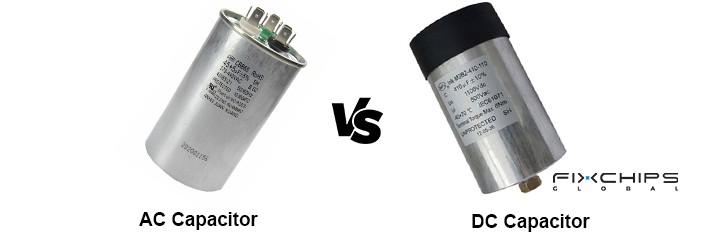
|
Feature |
AC Capacitors |
DC Capacitors |
|
Purpose |
Motor starting, motor running, AC filtering, power applications |
DC filtering, energy storage, coupling, DC-link applications |
|
Polarity |
non-polarized |
polarized or non-polarized |
|
Dielectric Type |
Metallized polypropylene film,other dielectric types |
Electrolytic, ceramic, film, and other dielectric technologies |
|
Terminal Types |
Fast-on, tabs, lugs, wires, and others |
Radial leads, axial leads, screw terminals, snap-in terminals, and others |
|
Shapes |
Round or oval |
Cylindrical, box-shaped, disc, rectangular, and other forms |
|
Applications |
AC motors, compressors, fans, pumps, HVAC equipment, AC filters |
Power supplies, DC links, electronic circuits, energy storage, filtering |
AC Capacitor Types
The first step in choosing an AC capacitor is to identify its job. A capacitor designed for short starting periods may not be suitable for continuous operation.
Start Capacitors

A start capacitor helps a motor begin rotating. It provides additional starting support during the brief period when the motor starts from rest.
A switching device usually disconnects it after the motor reaches the required speed. Start capacitors are not intended for continuous operation unless the product is specifically designed for that purpose.
They are used in some single-phase motor applications, including certain pumps and compressors.
Run Capacitors

A run capacitor stays connected while the motor operates. It helps maintain the phase relationship needed for normal motor performance.
Many motor-run capacitors use metallized polypropylene film. Their capacitance, voltage rating, and temperature limits depend on the product design.
A run capacitor must match the motor's specified electrical requirements. A similar case size does not mean two capacitors are interchangeable.
Dual-Run Capacitors
A dual-run capacitor combines two capacitor sections in one case. It is commonly used in air-conditioning equipment when the compressor and fan motor require separate capacitance values.
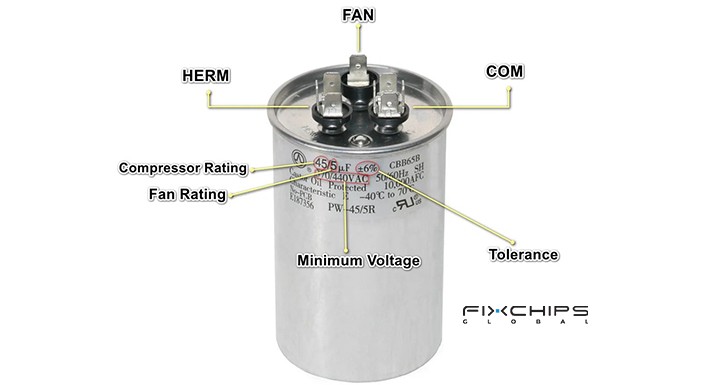
For example, a label may show 45 + 5 µF. This indicates two capacitance values, not one combined value for every connection.
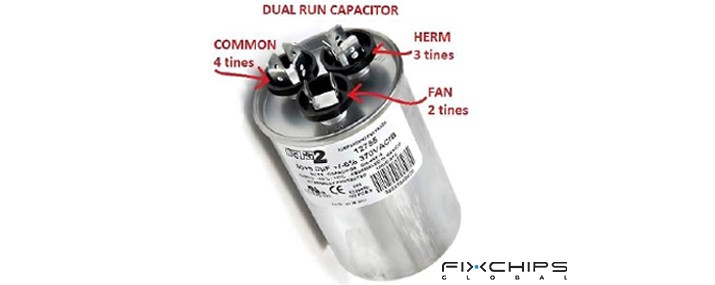
Common terminal markings include:
- C or COM: Common connection
- HERM: Connection for the compressor in compatible systems
- FAN: Connection for the fan motor
AC Filter Capacitors

Filter capacitors serve a different purpose from motor-start and motor-run capacitors. They help control unwanted frequency components in electrical circuits.
They may be used in AC power filters, converters, and inverter systems. Their design depends on the voltage, current, frequency range, and safety requirements of the application.
A general-purpose motor capacitor should not automatically be used as a filter capacitor. The intended application and relevant product ratings must be checked.
Where Are AC Capacitors Used?
AC capacitors appear in many electrical systems. Their function depends on the design of the equipment.
|
Application |
Typical Role |
|
Air conditioners |
Support compressor or fan motor operation |
|
Fans and blowers |
Help compatible motors start or run |
|
Water pumps |
Support operation of certain AC motors |
|
Refrigeration equipment |
Help suitable compressor motors operate |
|
Industrial equipment |
Support specific motor or power circuits |
|
AC power filters |
Help control selected unwanted frequency components |
|
Converters and inverters |
Serve as filter components in suitable designs |
How to Read AC Capacitor Ratings
A capacitor's label provides key information for selection and replacement. Three important items are capacitance, rated voltage, and frequency.
Capacitance
Capacitance indicates how much electric charge a capacitor can store at a given voltage. It is commonly measured in microfarads (µF) for AC motor capacitors.
For example, a 35 µF capacitor has a capacitance of 35 microfarads. This number must match the value specified for the motor or equipment.
Rated Voltage
The voltage rating shows the AC voltage the capacitor is designed to withstand under specified conditions.
Common motor-capacitor ratings include 250, 370, 400, and 440 VAC. Other ratings are also available.
The replacement must meet the equipment's voltage requirements. Do not use a capacitor with a lower rating than required, and do not assume that a higher rating makes every replacement suitable.
Frequency
Frequency measures how many AC cycles occur each second. It is expressed in hertz (Hz).
Household power systems commonly use 50 Hz or 60 Hz. However, the correct capacitor depends on the operating conditions for which it was designed.
IEC 60252-1 covers certain AC motor capacitors used with asynchronous motors in systems with frequencies up to and including 100 Hz. This scope does not mean every AC capacitor is suitable for every frequency within that range.
Other Label Information
A capacitor may also show its temperature rating, tolerance, terminals, and safety approvals.
Check these details when choosing a replacement. They can affect whether the part fits the equipment and operates under the required conditions.
How to Choose a Suitable AC Capacitor
A reliable selection starts with the equipment specifications, not the price or appearance of the part.
Step 1: Identify the Required Type
Determine whether the circuit needs a start capacitor, run capacitor, dual-run capacitor, or filter capacitor.
Step 2: Match the Capacitance
Check the required µF value. For a dual-run capacitor, verify both capacitance values.
Step 3: Check the Voltage Rating
Choose a product that meets the equipment's AC voltage requirements. Never use a lower-than-required rating.
Step 4: Confirm the Frequency and Temperature
Check the expected operating frequency and temperature against the capacitor's specifications.
Step 5: Check the Terminals and Mounting
Confirm the terminal arrangement, case dimensions, mounting method, and available space.
Step 6: Review Safety Requirements
For mains-connected equipment, use a capacitor designed for the intended application and follow the equipment manufacturer's requirements.
IEC 60252-1 is a relevant standard for AC motor capacitors within its defined scope. Other applications may require different standards.
Step 7: Compare Cost and Product Quality
Price can vary with capacitance, voltage rating, construction, temperature rating, and certification.
A lower price does not automatically mean poor quality, and a higher price does not guarantee a better fit. Compare specifications, product documentation, and suitability for the application.
What Problems May a Incorrect Capacitor Cause?
A capacitor may fit the mounting bracket but still be unsuitable for the circuit. Incorrect electrical ratings can affect motor operation and component life.
Common problems include:
- Incorrect capacitance: May affect starting torque or normal motor operation.
- Insufficient voltage rating: May increase electrical stress and shorten service life.
- Wrong capacitor type: A start capacitor may fail if used continuously when it is not designed for that purpose.
- Incorrect terminal connections: May prevent the motor from operating correctly or damage equipment.
- Unsuitable operating conditions: Excess heat or other stresses may reduce service life.
Signs of a Failing AC Capacitor
A failing capacitor can affect motor operation, but symptoms alone cannot confirm the cause. Wiring problems, faulty switches, damaged motors, and other electrical issues may produce similar signs.
Starting Problems
A motor may fail to start, start slowly, or repeatedly attempt to start. A faulty start capacitor or run capacitor can be one possible cause.
Reduced Performance
A motor may run poorly or become unusually hot. An incorrect or deteriorated capacitor may contribute to this behavior.
Other causes include mechanical problems, poor connections, and unsuitable operating conditions. A proper inspection is needed before replacing the capacitor.
Unusual Sounds or Smells
A humming motor, repeated clicking, or a burning smell may indicate an electrical problem.
If the equipment smells burnt or shows signs of overheating, stop using it and arrange a qualified inspection. Do not assume that replacing the capacitor will solve the problem.
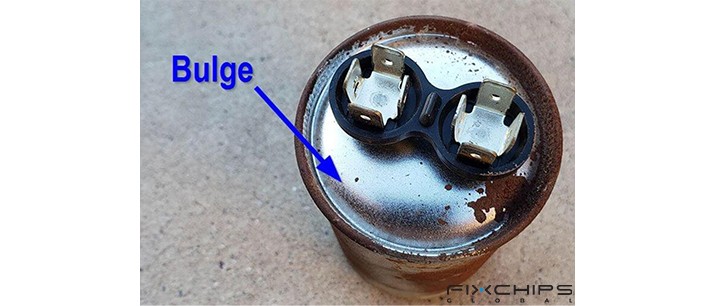
Visible Damage
Look for signs such as:
- A swollen or bulging case
- Leaking material
- Burn marks
- Damaged or corroded terminals
These signs can indicate damage, but some failed capacitors look normal. Electrical testing may be needed to confirm their condition.
AC Capacitor Replacement: Safety First
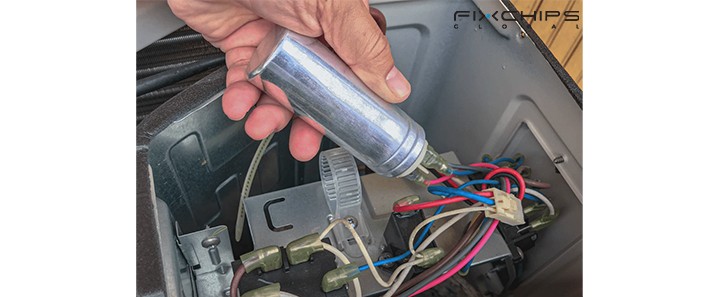
An AC capacitor can retain a dangerous electrical charge after power has been disconnected. Switching off the equipment does not guarantee that the capacitor is safe to touch.
Replacement should be performed by a qualified person who follows the manufacturer's procedures.
|
Step |
Required Check |
Safety Point |
|
1 |
Identify the original capacitor and its ratings |
Do not rely on appearance alone |
|
2 |
Isolate the equipment from its power source |
Never work on an energized circuit |
|
3 |
Verify electrical safety |
Stored energy may remain after power is disconnected |
|
4 |
Record the original terminal connections |
Incorrect wiring can damage the equipment |
|
5 |
Confirm the replacement specifications |
Match the type, capacitance, voltage, and connections |
|
6 |
Check the mounting and wiring |
Connections must be secure and properly protected |
|
7 |
Verify normal operation |
Stop if abnormal noise, smell, or overheating occurs |
Note: Do not attempt this work without suitable training and tools. Follow the manufacturer's discharge and safety procedures, and have a qualified technician inspect the equipment when necessary.
Frequently Asked Questions
What is the main job of an AC capacitor?
An AC capacitor stores and releases electrical energy as voltage changes. Depending on the circuit, it can support motor starting, motor running, or electrical filtering.
Can a start capacitor be used as a run capacitor?
Not unless the capacitor is specifically designed and rated for that use. Start capacitors are generally intended for short periods, while run capacitors are designed for continuous operation in their specified applications.
Is a higher voltage rating better?
Not necessarily. The voltage rating must meet the circuit's requirements, but capacitance, capacitor type, temperature rating, and other specifications also matter. The replacement must be suitable for the intended application.
Can you replace an AC capacitor yourself?
Replacing an AC capacitor is not recommended for people without suitable electrical training. A capacitor can retain a dangerous charge after power is disconnected. A qualified technician should follow the correct discharge and replacement procedures.
How can I choose the correct replacement capacitor?
Check the required capacitance, AC voltage rating, capacitor type, terminals, mounting dimensions, and operating conditions. Use the equipment manufacturer's specifications rather than choosing a part based only on its appearance.
How much does it cost to replace an AC capacitor?
The cost depends on the capacitor type, equipment, location, and labor charges. A replacement part usually costs less than a complete repair service. Ask for a quote that separates the part cost from inspection and labor.
Related Articles
MLCC - Types, Electrical Properties, and Selection
What Is a Variable Capacitor? Types, Uses and Working Principle


